Press
Lisson x RCA present Wild Woods Forlorn symposium with John Akomfrah
‘Tishan Hsu: The Human Inside’ - ArtAsiaPacific
Lucy Raven Presents ‘Level Distance’ at Sun Valley Museum of Art
Marina Abramović Presents ‘Historical Works and Transforming Energy’ in Rome
Leiko Ikemura and Haroon Mirza to Participate in Helsinki Biennial 2027
Sir John Akomfrah Featured in the 2026 Wuhan Biennale
News
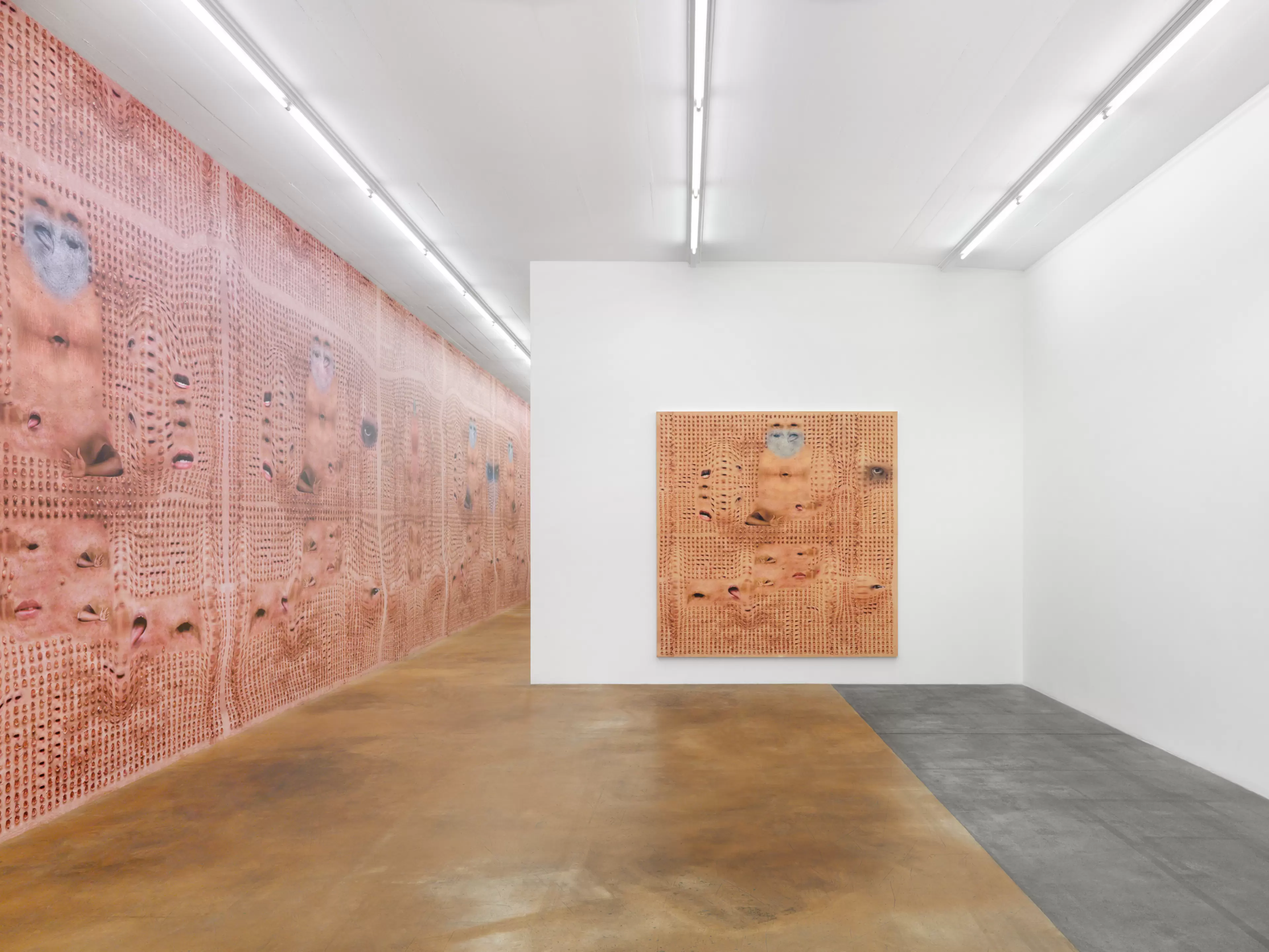
Installation view of Tishan Hsu’s exhibition at MAMCO Geneva, 2024. Copyright the artist and Artists Rights Society, New York. Photo by Annik Wetter. Courtesy Lisson Gallery.
“There is always something definitely nonhuman, yet almost definitely alive, inside the art of Tishan Hsu: a presence behind the screen, muffled yet persistent, pressing toward release. Across four decades, through a singular lexicon that fuses biomorphic and techno-machinic forms and textures, the 75-year-old artist has registered not simply the digital age’s effects on the body but its incursion into embodiment—the ways monitors, medical imaging, apparatuses of surveillance, and artificial intelligence enter perceptual and psychic life. After a long eclipse, his practice has, since 2019, drawn a surge of attention that casts him as prophetic—the rounded corners of his 1980s panels prefigure the iPhone, while Closed Circuit II (1986) all but forecasts the Instagram logo—an artist who apprehended, far in advance, a mode of human life inseparable from machinic mediation. That belated legibility should give us pause: if the early work has only recently become recognizable as portraits of techno-bodily entanglement, then the current vocabulary for Hsu’s recent explorations is almost certainly inadequate. What are his updated diagnoses? What new afflictions press against our skins and screens, asking to be named?
Born in Boston in 1951, Hsu spent his earliest years in Zurich, where his father was finishing an engineering dissertation, before the family moved through Ohio, Wisconsin, and Virginia. Hsu studied architecture at MIT, earning his bachelor’s in 1973 and his master’s in 1975, and took film and photography courses at Harvard’s Carpenter Center along the way. After moving to New York in 1979, he worked nights as a word processor at a law firm while devoting himself to his art. This is the artist’s most most-cited origin story: sitting before a screen for hours on end, he found that his physical body remained insistently, irreducibly present. His work has since set out to account for “this paradox between the illusionary world of the screen and the physical reality of [the] body.”1
During the 1980s, Hsu exhibited at Pat Hearn Gallery (1985) and Leo Castelli Gallery (1987) and moved to Cologne in 1988 for a two-year residency. Upon returning to New York, he deliberately stepped back from the commercial circuit, taking up teaching to sustain a practice not beholden to the market, dedicated purely to research and experimentation. His techniques morphed in step with proliferating technologies of imaging and information, expanding from painting, relief, and sculpture to silkscreen and photographic reproduction, followed by digital image manipulation, wide-format and UV printing, silicone and large-scale installation, Mylar, moving image, and, more recently, generative A
These procedures accumulate rather than supersede one another, each giving new form and affect to the fleshly disturbances that relentlessly plague his surfaces. Across successive decades and devices, something continually opens, swells, reaches, and strains, exerting to become audible. To follow these symptoms is to approach technological change not through the succession of its machinery, but through the forms of embodiment it brings into being.”